Thursday, May 31, 2012

The Brain Anchor


It’s not until I’m on 95, driving out to visit my dad, that I realize what to do with the fur hat tied by ropes to a cinder block in the trunk of my car, a “brain anchor” used as a prop by a friend in a surrealism creative writing class. My father not only introduced me to the world of surrealism when I was a child, he currently inhabits one of his own.

I’d called him the day before to ask his permission to write about him because, I tell him, there’s nothing else right now I can imagine writing about. Still, I feel like a vulture scavenging for blood. “Oh, of course you can,” he says, surprising me as he always does with his generosity. “I would be honored.” And then he suggests I write an even longer article for a national magazine, because people love to read about other people’s dying parents.  

“But, Dad!” I say horrified. “You’re not dying!”  

“I’ve had another home invasion,” he tells me. “It’s time to stop driving. I’m deteriorating, Valley,” he says. 

“What kind of home invasion?” I ask, but I already know. After suffering a series of micro strokes two years ago he began to undergo a string of MRI’s and psychiatric evaluations which have turned up the words inconclusive, abnormal and dementia.  

 Perhaps I’m biased, but I prefer my dad’s definition of his shifting mental state to anything I’ve found online. His first extended hallucination he described as a “cosmic, horrific supernatural freak show of southern holiness.” A tall man with lobster claws for hands and his very short 300 pound wife, who, together looked like a period and an exclamation point, were the leaders of the pack. “They were hungry and fat and wanted peanut butter sandwiches,” he told me. “I thought I was going to be killed, maybe eaten.” Between trying to beat them away with pillows and making them peanut butter sandwiches, my father called my stepmother and begged her to call the sheriff. She’d assured him it wasn’t real and asked him to hang on until she got home. “I know they’re hallucinations,” he tells me. “But the real question is, are they still there when I’m gone?”

             When I sob to a friend on the phone, the gravity of the situation finally hitting home, she says, “It’s like watching a redwood fall in the forest.” And she’s right. My dad has always been fit and tall and handsome but I think it’s the largesse of his imagination she’s referring to. Growing up, he always kept an open house, an open mind and a tendency to regard the lines between reality, dreams, poetry, fiction and fact more like suggestions than absolutes. As a child, he opened up for me the world of story. Now, at 63, his mind is writing a whole new chapter.

The characters that populate his imagination visit his waking life as well. Civil War soldiers ride up to him on horse back; furry white animals streak the yard; pterodactyls soar through the house. But it’s the confusion, the memory loss and the fat illiterate family of rednecks, the home invaders, with whom he’s had to make his peace. “I’m much more welcoming to them now,” he tells me. “Which makes them go away faster. The lesson here is that no evil can stand up to humor!” 

When I pull into my dad’s driveway he’s bright eyed, holding a riotous fistful of purple irises from his garden. I drive him around to do the things he can no longer do by himself and when we’re done, because I don’t know what else, other than my time, I can give him, I pull the brain anchor out of my trunk. “It’s perfect!” he says and shows me a sculpture in the front yard made of bits of metal and discarded scraps of wood. “I call it stacking,” he says. And he explains to me his new art form, one that takes on different shapes and unexpected dimensions, becoming more bizarre and more beautiful each day.


Tuesday, May 1, 2012

Breast Invasion


Breasts are magical. They have the power to transform girls into women, babies into children, and men into…well, everyone with breasts has their own version of that. My own arrived suddenly, like extra terrestrial twins on a pleasure cruise forced to make a crash landing when their ship went down. I woke up one morning with a brand new atmosphere and gravitational pull. I still occasionally check for moons, rings or anything else that will allow me to apply for separate status in our solar system. Compared to my chest, poor little Pluto never stood a chance.
My extra endowment is not without its ups and downs. I have never had to wonder what it felt like to be a twiggy model with the figure of a 12 year old boy, which is a plus, but I did have to visit a special garment store where I was introduced to womanhood by a hunchbacked old lady with a measuring tape. That “bra”—or what my husband refers to more accurately as my “over-the-shoulder-boulder-holder” was reminiscent of a medieval torture device, if torture devices had more straps and levers. When it accidentally caught fire on a ranch in Colorado I did not mourn its lost. My back, however, did. I’m still amazed Victoria’s Secret doesn’t employ a team of engineers working around the clock to solve the world’s large breast crisis once and for all.

I finally saw the twin’s true virtue when I used them to feed my son, but since he has no memory of nursing, he recently asked if we could give it another go. “Get your own!” my husband yelled which may well be my son’s quest one day. But since he is a confirmed only child, and my chest is in retirement from its service as a food bank, I have started to think about them differently once again. Especially when a tender, sore spot in the one on the left struck the fear of God--and breast cancer—into a place right next to my heart. 

To avoid the dreaded mammogram, I choose an alternative route, scheduling my first ever breast exam with certified clinical thermographer, Eleina Espigh, owner of Virginia Clinical Thermography in Glen Allen. Former executive director of the Virginia Osteopathic Medical Association, Espigh co-located her private practice with a massage therapist three years ago and entering a room more like a spa than a sterile, white lab immediately puts me at ease. Espigh answers all of my questions, explaining that thermography is a noninvasive diagnostic technique used to monitor changes in skin surface temperature. “People are becoming more aware of the dangers of exposure to radiation inherent in a mammogram, and seeking out thermography as a safer alternative,” she says. And though she also uses thermography to effectively diagnose pain, fractures and other injuries to the body, the larger percentage of her patients seek out thermography to detect breast cancer in its earliest stages.

After I fill out the paperwork and Espigh explains that today’s exam will establish a baseline to be followed by regular checkups, she asks me to take off my shirt and raise my hands above my head. “Your breasts are quite large,” she says, “but there are worse problems to have.” We laugh, and as she takes pictures from the front, back and side, she points out dark orange streaks on the computer screen that match the tender spots on my chest. I have fibrocystic tissue, she tells me, a common condition that may be treated by simple dietary changes. A board certified thermalogist will interpret the images and confirm what Espigh tells me in a detailed report that I’ll receive later that week, but for the moment, I thank her and my lucky stars, that for the time being I don’t have to adapt to any new alien invasions. The ones I’ve already had are enough for this lifetime.


To schedule a thermography appointment, visit www.vathermography.com, call 804-454-4540 or visit the Virginia Thermography Clinic at Good Foods Grocery in Gayton Shopping Center the last Saturday of every month.  

Friday, April 6, 2012

Raw Fresh Things: The Fine Art of Falling Apart


Act 1:

I've been lost in that part of the labyrinth where you can’t see ahead or behind and you’re too short to climb over the hedge-- that locked up bit that causes young parents to call the police and David Bowie to take acting jobs with muppets. Floating through a murky haze as if I've taken a red-eye from Istanbul, jetlagged, but from life, there’s something more going on than I can find in the mirror. I’ve been tender and sad and unsure, like there’s a little girl inside that’s been shattered over something-- a bad grade or a bad boy or both-- and the big girl that's in there too must care for her but she feels like putting on black eyeliner and black boots and stomping around with her friends before taking the time to apply the band aids and find the tissues to wipe up the tears. I can’t tell if I’m making up the story or merely recording it, but I know it’s a footnote to the void, the luggage compartment of the hole, that space that gets emptier and hungrier than a vacuum cleaner refill bag if I’m not vigilant, a vortex in me that wants more, more of anything, even a bad thing, especially a bad thing-- if it’s familiar. I think being tired is the red carpet for tears and so today I’ve let them roll.

Act 2:

Fine, tears, deliver your message. I’ll welcome all of you now, even though if life were a menu I would have ordered blissfully happy for every course. Even though blissfully happy is actually a bit watered down—jacked up ecstatic is more like it. In the past and even the present I haven’t been above using whatever crutch I could get my hands on to get me there. But these tears, this welling up of something can’t be denied just because I have a longing for an imaginary crack house in heaven. They’re here for some reason and what I hear them saying  is I have more to give than I’m giving. I’ve been holding back and the result is a log jam that can’t help but spill over. I’ve been holding back because over exposure isn’t cool and raw fresh things are easy targets for skewers and sometimes I want to put a heavy blanket of books and HBO specials and iPhone apps around this needy pulsating thing that gets me up in the morning and moves me around during the day. When I don’t write with that blanket stripped away and my heart completely naked it’s like having the harvest from my own garden rot in the fridge while I eat CheezDoodles and HoHos and Hot Pockets from the microwave. I need to call myself back, all of me, so I can be funneled into the important pieces of my life, this work, right here.

Act 3:

I want to build a closer, steadier, more reliable relationship with my art. I want to be close like husband and wife or mother and son or two best friends who finally shacked up together, not like those people you duck into another aisle to avoid at the market because you missed the real appointment with them long ago. I want a rich, deep, daily relationship that self propels like a La-Z-Susan circling back around again and again, serving me as I serve it, my writing and me, eating breakfast together at the table. I want to take new risks regularly, going beyond the flimsy invisible walls I treat like steel. I want my art and me to know each other like bread and butter, like skin and bone, not third cousins twice removed at the family reunion. I want my art and me to be buddy-buddy, not just pen pals where one person suddenly stops writing back, but blood brothers, blood sisters, who can’t get to the door fast enough to say everything, that did or didn’t happen, was or wasn’t there. I want my art and me to go for fancy restaurant dinners but to come home together and lock the door from the same side, no one shut out, no one alone. I want art and me to drink milk straight from the jug, one after the other without apologizing for being unseemly, without embarrassment, without threatening to leave to find more distant, polite and acceptable company. Because this is the only way out of the labyrinth I know. 


Monday, April 2, 2012

Born Here, Been There: American, East Coast & Southern


Over the last several years the same Feng Shui consultant has told me twice, in no uncertain terms, that there is no hope for our house that can be bought by charms or rearranging of pillow placements and that the best thing for us to do is to move, preferably yesterday. Both times I’ve agreed with her. There’s baggage here, ghosts, my parent’s past and my own, not to mention structural and aesthetic repairs that seem to be well beyond our scope. But, much as my mind is made up to get out of dodge for a full 24 hours after she leaves, we stay. 


It’s as if she’s told me to step out of the quicksand. She’s right; I just can’t seem to do it.

Mulling over my plight with a friend I heard myself say, “I’m just not like all these white Westend women!” Maybe because she’s from California the truth was more obvious to her. “But you ARE a white Westend woman!” she said. It was an epiphany. Not having an excess of national, regional, cultural, house or any other kind of pride, my geographic identity is something I’ve wrestled with most of my life.  

At the predominantly African American elementary school I attended in Church Hill, there was little I could do to hide the fact that I was white and Jewish—especially after my mother’s classroom Hanukah presentation. But after being transferred, I didn’t feel like I fit in any better at the almost entirely white conservative school in my own neighborhood where I was the only kid who didn’t vote for Ronald Reagan in our class mock election.

At school in New York, one had to dig deep to unearth my southern roots. Southerners were backwards, redneck racists who spent all their time reenacting Civil War battles-- if they weren’t too busy eating grits. I was busy eating grits, but if I’d been in the Civil War, I would have gone Union. Likewise on the dude ranch in Colorado, I was loath to admit my East Coast origins. Easterners were neurotic academic snobs who didn’t know how to brew a decent cup of cowboy coffee or saddle a horse. I had to learn both the hard way. Living in Italy, I did my best to disguise the fact that I was American. Americans wore fluorescent visors, ugly fanny packs and brayed like donkeys in the museums and churches meant to honor the dead. My ruse was successful until I opened my mouth, effectively butchering the native tongue of Dante and Boccaccio in a single espresso order. 

But I have a feeling if I’d moved to Mars I would also have tried to refute my humanity.

As hard as I tried to leave my American, East Coast, Southern roots behind, they pulled me back, not only to Richmond, but to the house I grew up in. Maybe my mother buried my placenta in the backyard. Maybe the souls of the cats we’ve put to rest out by the fence line steal our breath while we sleep. Maybe I accidentally married my house when I married my husband. Maybe I’m trying to straighten out my childhood by raising my own child in my old bedroom.
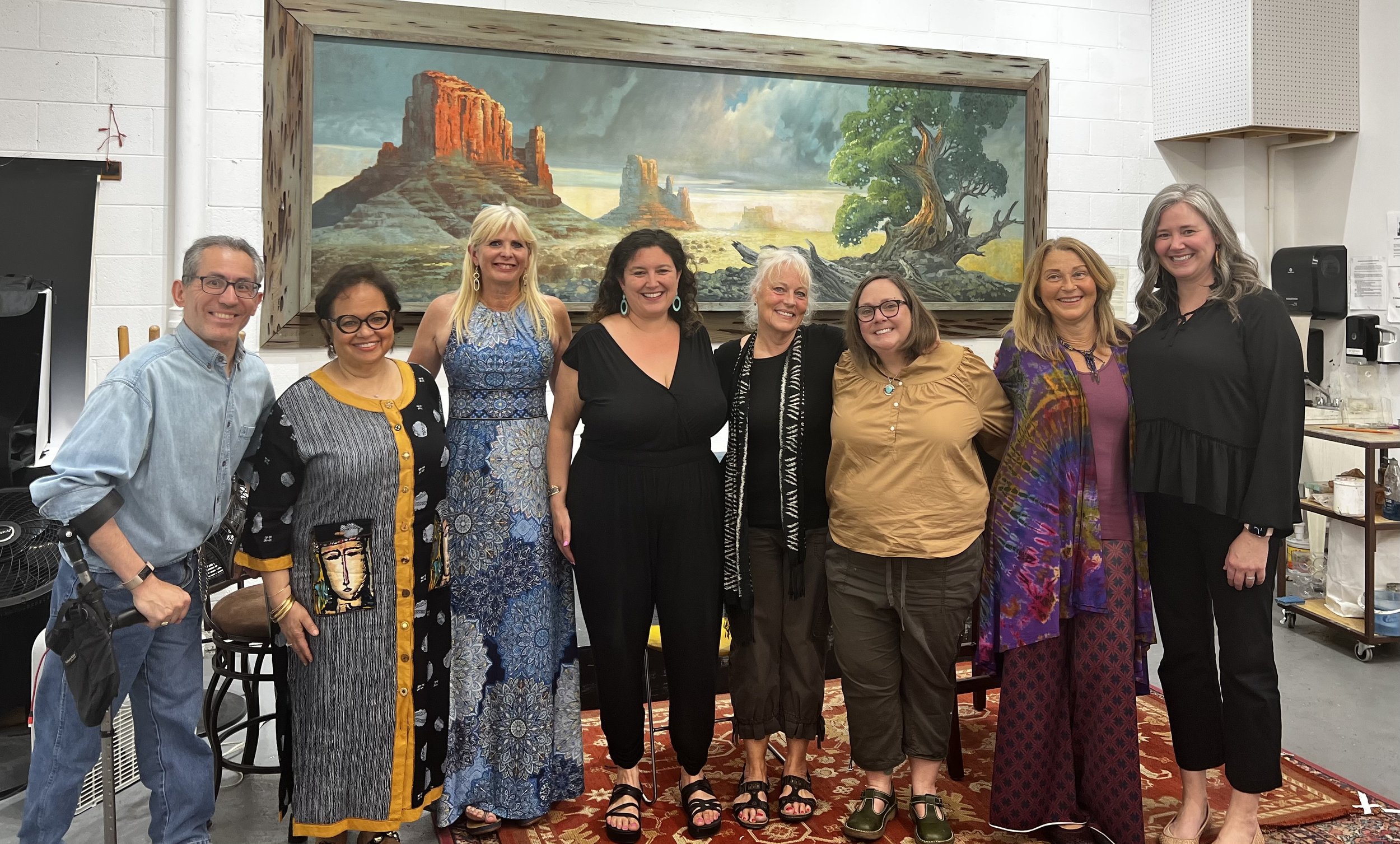
Whatever the reason, I’ve not only ceased trying to divorce myself from my hometown, I’ve fallen in love with it, too. Just as one can’t get to know everything about another person in a single lifetime, the city where I’m from will always offer more to discover. Even though a trip to the grocery store can be like attending my own high school reunion, Richmond has more interesting neighborhoods and quirky personalities than a dysfunctional family has alcoholic uncles. My definition of love has always been wide, but coming back to stay has allowed it to grow deep. The castles I build in the sky might spring from quicksand, but at least I’m finally proud to say they’re mine.